For counsel and in-house legal
What an extract from this archive contains, what it answers, and what it does not
What MachineWitness is, in one paragraph, if this is the first you hear of it: since 22 July 2026, two independently operated machines have recorded, every day without exception, what around 128,000 EU domains serve to machines and to visitors, and sealed that day’s record so that nobody, including us, can alter it afterwards. What that means for you: when a client needs to prove what a page said on a specific day, the proof was already being made before the dispute existed, by someone with no stake in the outcome.
A dated record of what a domain served to machines on a given day, made by a third party that did not know your matter existed, sealed into a public root that same night and anchored outside this archive three times over. Not a screenshot, not a crawl of page content, not an opinion.
What that record actually contains: the exact HTML document (or other file, such as robots.txt) the server sent that day, byte for byte, plus the response headers and the TLS certificate chain, the same text a browser would receive, stored unchanged. Not a screenshot, and not how the page rendered on screen: CSS, layout and anything requiring a browser to display are outside what is recorded. Where a dispute turns on the words a page carried, that is exactly what this preserves; where it turns on how prominently something was displayed, say so when you write to us, since that changes what can be offered.
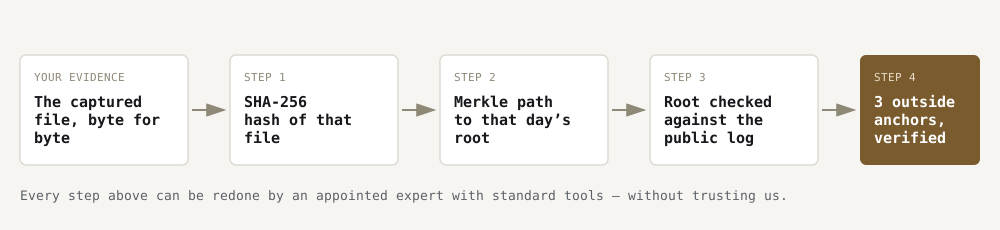
The point of the construction is that you do not have to vouch for us. Every step can be repeated by an appointed expert with standard tools: recompute the hash of the file, rebuild the path from that hash to the day’s root, check the root against the public log and against the external anchors. Where that check is itself the subject of a dispute, read how it works before you order anything.
What it answers, and why that is usually the whole problem
Without a third-party record, you are left assembling proof yourself: a screenshot the other side can call doctored, a server log that is your own client’s word, or a commissioned forensic capture ordered only after the dispute already started, too late for the day that matters. One ordered extract replaces all three:
- What did this domain serve on that day, byte for byte, in the files a machine reads?
- At what moment exactly, in UTC, and was the request answered or refused?
- Since when has this been recorded, and when did it change?
- What did the crawler operators and AI providers publish on that same day?
- Can a third party verify all of it without us?
What it does not answer
- How the page looked. We record bytes, not pixels, and appearance is not our subject.
- Anything behind a login, and anything this archive did not observe on that day.
- Whether any of it was lawful. We do not rate, do not rank and do not advise.
- Whether a particular crawler actually visited your client’s server. That is a different record, and we say so on the product page rather than blur it.
Where to start, with an example for each
Two starting points, and it matters which one you are in. If the domain is already inside this archive’s observed set, what it served day by day is already there, however far back the observation reaches, the coverage check tells you in seconds, at no cost. If it is not, an extract ordered today captures it from today onward: not retroactive, but made by a neutral third party and sealed that same night, which still outweighs a screenshot taken under your own client’s name.
Competition, unfair-competition and IT law. The situation usually already has a date on it: a claim or a disclosure that stands on the other side’s page today and may not stand there tomorrow. Write to us with the page and the date that matters, and we will tell you in writing, before anything is charged, what this archive can capture for you and on what terms. See services and fees for what is already published.
ExampleA competitor’s site carries no imprint, or a tracking script not disclosed anywhere in its privacy notice, both sit in the page’s source, not just in how it looks. That domain is not yet observed, so you order an extract today, naming the URL; it is sealed the same night. From that point, what the source carried is fixed and provable, whatever the competitor edits tomorrow.
Trademarks and domains. Who held a domain, which name servers it used and what its pages carried are questions this archive can answer once the domain is under observation. The coverage check says free of charge whether that is already the case for yours. Where a longer domain history is what a proceeding needs, write to us with the domain and we will tell you what this archive already holds and what it would take to add more.
ExampleA domain confusingly similar to your client’s mark now redirects to a lookalike shop. The coverage check shows since when it has been observed here; a requested extract shows what it served on named dates, a record for a UDRP complaint or a court filing that rests on an operator with no relationship to either side, not on the registrant’s own account of events.
Copyright, publishing, rights-holders. The reservation against text and data mining, as it was served day after day, set next to what the crawler operators and AI providers published on those same days. Both halves come from the same archive, at published fees, to either side. See AI crawling record.
ExampleA publisher adds an AI-training opt-out to their robots.txt in July. Months later, their content turns up in a chatbot’s output. The sealed daily record shows the opt-out was already being served before that date, established by a party with no interest in either the publisher or the AI provider prevailing.
In every case, the document itself is the evidence extract: one domain, one kind of file, up to twelve months, as PDF and ZIP with instructions to verify. The general method sheet is included, at no extra charge.
Firms and legal departments
One account for a firm or a legal department, with client domains, named pages and captures underneath it, and one collected invoice per month. Every item at the published list price, no discounts and no volume terms, because a fee that depends on the customer would defeat the purpose of the archive. A named contact for technical questions. You may name this archive to your clients; we do not name you, to anyone, ever.
Ask by e-mail to contact@machinewitness.eu. We answer in German, English or Spanish.
Neutrality, and why it is in your interest
This archive belongs to no party. The opposing side can order the same extract, at the same published fee, and we do not tell either of you that the other asked. We do not notify, do not mention the applicant and give nothing to whoever pays that a third party would not also receive. That is not a limitation of the document you are filing: it is the reason it carries weight in the first place, and it is the first thing you should expect to be asked about it.
What follows from any of this in your matter is for you to say. We do not advise and take no side.