Evidence extract
What a domain served on a given day
The public pages of this archive answer whether a domain is observed and from when. They never publish content. What a file actually said on a given day is issued as an evidence extract, on request, at the published fees.
Request an extract → The fees are on the services page; nothing on this page sends anything anywhere.
Where this is used
Case 1A reservation that was in force, and a use that came afterwards
A publisher declares in the spring that its texts are not available for text and data mining, in the files a machine reads. In the autumn it is in dispute with a provider about whether that declaration was in force on a particular day, and in what words. The file has been edited twice since then, for ordinary reasons, and neither side kept the earlier versions.
An extract answers that day: the file as it was served, its fingerprint, the moment of retrieval, and the chain to a seal that was published and anchored the same night. What follows from it is argued by the parties; the archive states what was there.
Copyright and IT law · publishers · providers
Case 2Terms that changed between the order and the argument
A customer orders on a Tuesday in March. The dispute begins in September, and by then the page carries a different price, a different delivery period and a different clause about cancellation. Both sides remember the old page differently, and a screenshot from either of them is a document that party made itself.
Where the address was observed, that Tuesday exists as it was served, recorded by a party that had no part in the matter and no knowledge of it. The same extract can be ordered by the other side, at the same published fee, which is what makes it worth anything to either of them.
Contract disputes · consumer matters · company counsel
Case 3A day nobody thought to keep
An appointed expert is asked what a public address served on a given date. The operator restored a backup in the meantime, the web archives of the world happen not to have that day, and the only accounts of it are the accounts of the two parties.
An extract covers the days this archive observed and sealed, and it says so plainly where a day is missing or where the address could not be reached. Nothing is reconstructed and nothing is filled in, because a record that fills in gaps is no longer a record.
Appointed experts · courts · both sides alike
What you receive
An extract is a PDF with a ZIP alongside it, covering one domain, one kind of file, and a period you name. It contains:
- The content itself, byte for byte as it was served, together with its cryptographic fingerprint.
- How it was obtained: the moment of the request in UTC, the response headers, the fingerprint of the TLS certificate presented at the time, and which of the two witnesses recorded it.
- The chain from that content to a published daily seal, step by step, so the content cannot have been altered afterwards without breaking it.
- The external anchors of that day, from both witnesses: a qualified electronic time stamp under eIDAS, an OpenTimestamps proof anchored in the Bitcoin blockchain, and the public root log.
- Instructions to verify every step yourself, with standard tools, without us.
The crawler-operator and AI-provider state of that same day can be ordered as a further kind of file in the same request: a context sheet next to your own reservation, at the same fee as any other additional file. See AI crawling record.
What it proves, and what it does not
The qualified time stamp is issued by a trust service supervised under Regulation (EU) 910/2014. Under Article 41 of that Regulation, a qualified electronic time stamp enjoys the presumption of the accuracy of the date and time it indicates and of the integrity of the data to which they are bound. That presumption is the reason an extract does not depend on our word: a court-appointed expert can recompute the chain and reach the same result, or fail to, without asking us anything.
What an extract does not prove: that the content was true, that anyone read it, that anyone was obliged to obey it, or that a domain served the same thing at a moment we did not observe. It proves that this content was served to this archive at this moment and has not changed since. What follows from that in your case is for you and the court to determine, not for us.
The archive is observational. It does not judge, rank, or accuse, and it does not tell you what your extract means.
What sealed means here
This block is the same on every page of this site, and it is repeated on purpose: it is the part you need in order to judge everything else.
- One fingerprint for the whole day. Every observation made that day, yours among hundreds of thousands, is reduced to a single hash through a Merkle tree. One changed byte anywhere in that day, and the fingerprint no longer matches. There is no version that could be quietly corrected.
- Published where anyone can see it. The fingerprint goes into the public log the same night, under a fixed, citable URL, together with the instructions for recomputing it.
- Handed out of the house three times on the same day. An RFC 3161 time-stamp service, a decentralised OpenTimestamps anchor in the Bitcoin blockchain, and a qualified eIDAS time-stamp from GLOBALTRUST (e-commerce monitoring GmbH, Austria), a qualified trust service provider listed on the EU Trusted List. The third of these is paid for and supervised, and it is worth saying so plainly: only the qualified time-stamp carries the presumption laid down in Article 41(2) eIDAS. A free anchor establishes that the data existed and has not changed, but it carries no presumption laid down by law.
- Twice over, by two witnesses that cannot write to each other. Two machines at two providers in two countries, with separate keys. Each seals its own day and takes its own anchors.
In plain words, two sentences. We cannot change a byte afterwards, because the day's fingerprint would no longer match. And we cannot backdate one, because that fingerprint has been in other people's hands since the night it was made. No one has to believe us: every step can be repeated with standard tools.
Further: how it works · what we store · glossary.
Does this stand up in court?
We cannot promise that, and nobody can promise it honestly: what a court accepts is for the court to decide. What we can tell you is what the document is made of, and each of the four facts below can be checked before you buy anything.
- It comes from a third party, not from you. Not your screenshot, not your server log. The bytes were fetched and stored by a third party that did not know your matter existed, on a day chosen by the calendar and not by the case. That is the difference between a record and an account of events.
- A presumption laid down by law. Every sealed day since 31 July 2026 carries a qualified electronic time-stamp from a qualified trust service provider on the EU Trusted List. Under Article 41(2) of Regulation (EU) No 910/2014 (eIDAS), such a time-stamp enjoys a presumption of the accuracy of the date and time it indicates and of the integrity of the data it is linked to. Article 41(1) says something much narrower, namely that a time-stamp may not be denied legal effect merely because it is electronic. The two paragraphs are routinely confused; the one that matters here is the second.
- Two independent witnesses. Two machines, two providers, two countries, separate keys. Each one seals its own day and anchors it externally on its own. Neither can write to the other, so neither can be corrected to match the other after the fact.
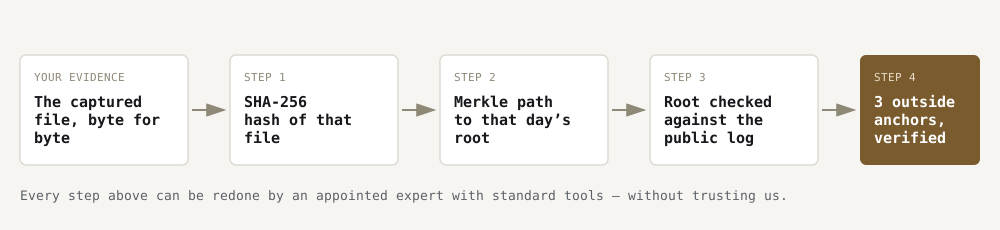
- Verifiable without us. An appointed expert repeats every step with standard tools: recompute the hash of the file, rebuild the path from that hash to the day's root, check the root against the public log and against the external anchors. We do not have to be believed, and that is the point of the whole construction.
What follows from this in your particular matter is for your lawyer to say. We do not advise, do not rate and do not take a side, and the other side can order the same document on the same published terms. That is not a weakness of the document. It is the reason it is worth anything.
How to request one
By e-mail to contact@machinewitness.eu. Four things are needed:
- the domain, exactly as it is registered;
- the period the extract should cover;
- which file is relevant: robots.txt, ai.txt, a TDM reservation, response headers, or all of them;
- the billing address, and a VAT number if you have one.
Check first, at no cost: the coverage check tells you in seconds whether this archive observes the domain at all and from which sealed day onward. If it does not, there is nothing to extract, and you have spent nothing finding out. Everything is handled in writing, by e-mail.
Or order one here.
Placing an order here is not concluding one. We confirm in writing what we received, then check the scope and tell you the fee for your case. Nothing is charged before you have that in writing, and you are free to walk away from it. If you would rather write the e-mail yourself, the address is contact@machinewitness.eu and it is answered by the same person.
Fees
All fees of this archive are published on one page, Services & fees. For an extract: 450 € covering one domain, one kind of file and a period of up to twelve months, 150 € for each additional file or domain in the same request; the further items are listed there. Net amounts plus VAT where applicable, invoiced by Martin Schenk S.L., Madrid.
A domain that is not yet observed can be admitted on request: observation on request, 150 € one-off.
The terms this is issued under
- The fee is fixed and does not depend on the outcome. There is no success fee and no arrangement that gives us an interest in how a dispute ends.
- Either side of a dispute receives the same extract on the same terms. We do not ask why an extract is wanted, and we do not decline one because the other side asked first.
- We take on no obligation to participate in proceedings: no expert witness work, no representation, no hearings, no appearances. What we provide is written and is provided from Madrid. Statutory duties of a witness, should a court impose them, remain unaffected.
- Our documents are produced with the help of AI under human supervision. They contain no opinion and no assessment, only recorded facts, the cryptographic chain, and the instructions to verify both independently.
- Nothing we issue is legal advice, and nothing in it is an opinion on your case. See the terms of use.
The four conditions above are reproduced word for word from section 5 of the terms, which is where they are binding; a check refuses to publish this site if the two ever diverge. Put plainly: a witness that could be engaged by only one party would not be a witness, we state the statutory exception rather than promise something a summons would override, and nothing in what we issue asks you to trust its author.